

By Polycarp Nwaeke
Port Harcourt was once widely admired as one of the most beautiful and organized cities in Nigeria. Known for its tidy environment, tree-lined streets, and carefully planned residential areas, the city proudly carried the nickname “Garden City.”
In earlier years, flowers, green spaces, and well-maintained roads gave the city a welcoming atmosphere that impressed visitors and residents alike. The Government Reserved Areas, in particular, reflected careful planning and environmental consciousness.
Because of this attention to cleanliness and order, Port Harcourt gained national recognition as one of the cleanest urban centres in the country. For decades, the Garden City reputation symbolized pride and progress.
Today, however, that once-celebrated reputation appears to be fading as piles of refuse increasingly dominate parts of the city.
Across several major roads and neighbourhoods, heaps of garbage have become a common sight, creating an unpleasant environment for both commuters and residents.
One of the most affected routes is the busy East-West Road, a major highway connecting several communities within the metropolis.
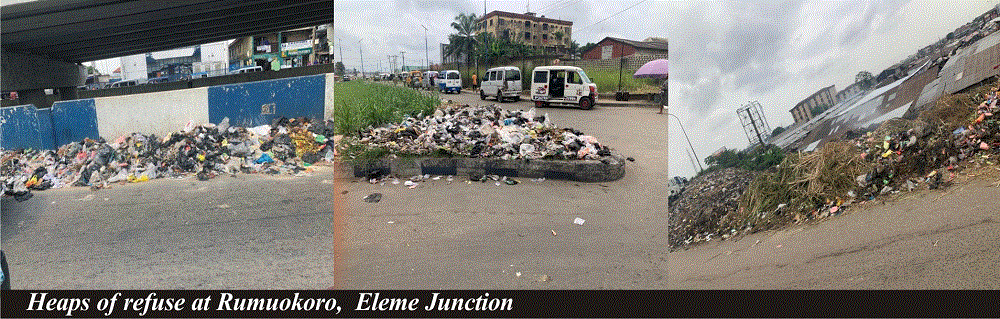
From Eleme Junction to Rumuokoro, large piles of refuse line the road, largely generated by roadside traders and nearby households.
At Eleme Junction, some of the waste dumps have grown so large that they spill onto the Aba-Port Harcourt Expressway, creating an unpleasant sight for motorists entering the city.
Much of the waste is linked to commercial activities around Oil Mill Market, where traders and pedestrians often dispose of refuse along the roadside.
Residents say many of these waste heaps have remained in place for months without proper evacuation.
In certain locations, the dumps have even become informal disposal sites for various kinds of waste, worsening sanitation conditions.
The situation continues from Oil Mill toward the White House bus stop in Rumuokwurusi.
Along this corridor, heaps of garbage are visible on both sides of the road, especially on the pavements meant for pedestrians.
What should be a major gateway into the city has gradually turned into an environmental concern.
The problem extends further along the East-West Road near the Omega Event Centre.
From that point, the piles of refuse stretch toward Rumuodara Roundabout and continue toward Rukpakulusi.
Waste accumulation is also visible around Bori Camp, where residents say the problem has gradually worsened.
At the busy Rumuokoro axis, the garbage heaps form what many describe as a mountain of waste approaching the flyover.
Near the Rumuokoro Flyover, a particularly large dump sits dangerously close to the main expressway.
At times, this buildup of refuse narrows the road and contributes to traffic congestion around the roundabout.
The sanitation challenge is not limited to that area alone.
Communities such as Rumuigbo, Rumuokwuta, and Rumuola also experience similar waste problems.
Areas around Mile One, particularly from Mile One Market toward Emenike, are also affected.
Other neighbourhoods such as Rumuomasi, Elekahia, and parts of Garrison face comparable sanitation challenges.
The responsibility for maintaining environmental sanitation in the city lies primarily with the Rivers State Waste Management Agency, commonly known as RIWAMA.
However, many residents believe the agency’s activities have slowed down in recent months.
The current Sole Administrator of the agency, Nwanosike, has remained largely out of the public spotlight, leading to concerns among residents about the agency’s effectiveness.
Some observers believe that recent political developments within Rivers State may have affected the operations of the agency.
During the tenure of Felix Obuah, many residents recall that sanitation efforts were more visible across the state.
Under his leadership, regular waste evacuation and environmental sanitation campaigns helped maintain the city’s clean image.
Today, however, the growing piles of refuse have become a worrying symbol of the city’s environmental challenges.
For many citizens, restoring Port Harcourt’s reputation as the Garden City will require urgent action, stronger environmental management, and cooperation between authorities and residents. Only through sustained effort can the city regain the beauty and cleanliness that once defined it.