

By Hopejane uzor
The race toward Nigeria’s 2027 general election is gathering momentum, but for the opposition coalition, the path is already fraught with legal uncertainty.
At the centre of the unfolding drama is the Independent National Electoral Commission (INEC), led by its chairman, Joash Amupitan, whose recent decision has triggered intense political debate.
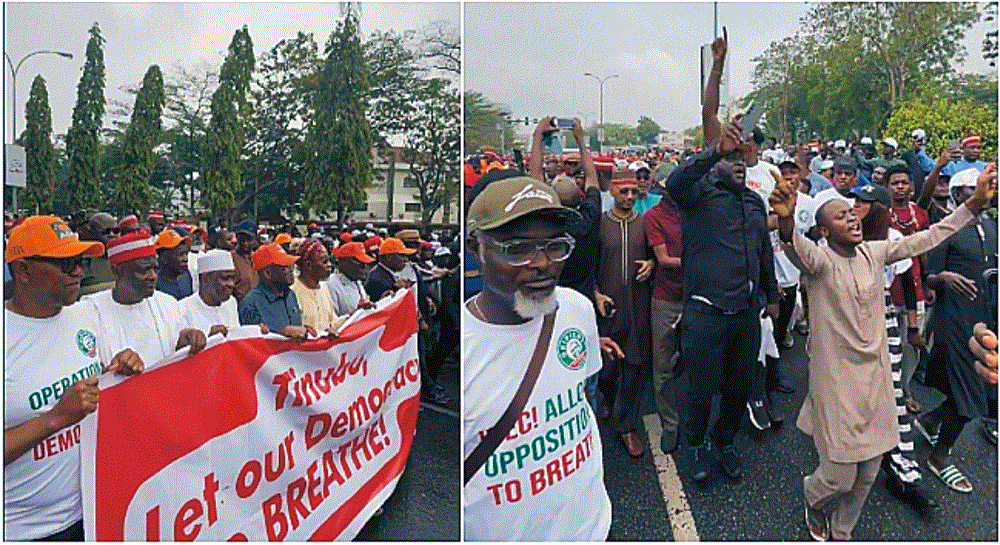
INEC’s refusal to recognise the National Working Committee (NWC) of the African Democratic Congress (ADC) led by David Mark has cast a shadow over the opposition’s strategy.
The commission insists its position is guided strictly by the law, pending the resolution of a leadership dispute currently before the courts. However, the ADC and its allies view the move as a deliberate obstacle to their growing coalition.
The decision has effectively plunged the party into uncertainty, raising concerns about its capacity to field candidates in 2027.
For a platform that has recently attracted prominent figures, including Rauf Aregbesola and Rabiu Kwankwaso, the timing could hardly be worse.
At the heart of the crisis lies a contested transfer of leadership. Former party chairman Ralph Nwosu had attempted to hand over control of the party to the coalition block.
However, rival factions, including those led by Dumebi Kachikwu and Nafiu Bala Gombe, argue that Nwosu’s tenure expired in August 2022, rendering any such transfer invalid.
Should the courts uphold this argument, the implications could be far-reaching.
The entire agreement that brought the coalition under the ADC umbrella may be declared void from the outset, leaving the opposition scrambling for a viable political platform.
INEC’s stance marks what some analysts describe as a shift toward “pre-emptive neutrality.” Rather than waiting for final judicial pronouncements, the commission appears willing to suspend recognition of party leaderships once credible legal challenges arise.
While this may be framed as strict adherence to due process, critics warn it could encourage factions to weaponise the courts to stall political opponents. For Professor Amupitan, the situation presents a delicate balancing act.
Compliance with a subsisting court order shields the commission from contempt proceedings, yet it exposes INEC to accusations of partisanship.
Opposition figures argue that by recognising the claims of the faction led by Nafiu Bala Gombe, the commission is inadvertently aiding efforts to destabilise the coalition from within.
The consequences of the decision are already evident. Without a recognised leadership, the ADC is unable to carry out critical functions such as voter revalidation, candidate nomination, or the organisation of congresses and primaries.
INEC has made it clear that any such activities conducted under the disputed leadership would be deemed invalid.
By referencing precedents in states like Zamfara and Plateau, Amupitan has reinforced the commission’s position that legal compliance is non-negotiable. Yet, these same precedents have become ammunition for critics who argue that the electoral body is overreaching into internal party affairs.
The ADC, however, is not backing down. Party leaders have vowed to challenge INEC’s decision in court while proceeding with planned activities. This defiance sets the stage for a prolonged legal battle that could ultimately determine the party’s fate ahead of 2027.
As the dust continues to rise, one thing is clear: Professor Joash Amupitan now stands at the centre of a political storm. Whether his actions will be remembered as a defence of electoral integrity or as a disruptive intervention in democratic processes remains to be seen. For the opposition coalition, the stakes could not be higher. With internal divisions deepening and legal uncertainties mounting, the promise of a united front against the ruling establishment is increasingly under threat. Until the courts deliver clarity, the future of the ADC—and perhaps the broader opposition movement—remains uncertain, overshadowed by doubt.