
When Regalia Betray Ethics: Integrity Challenges Among Africa’s Traditional Rulers

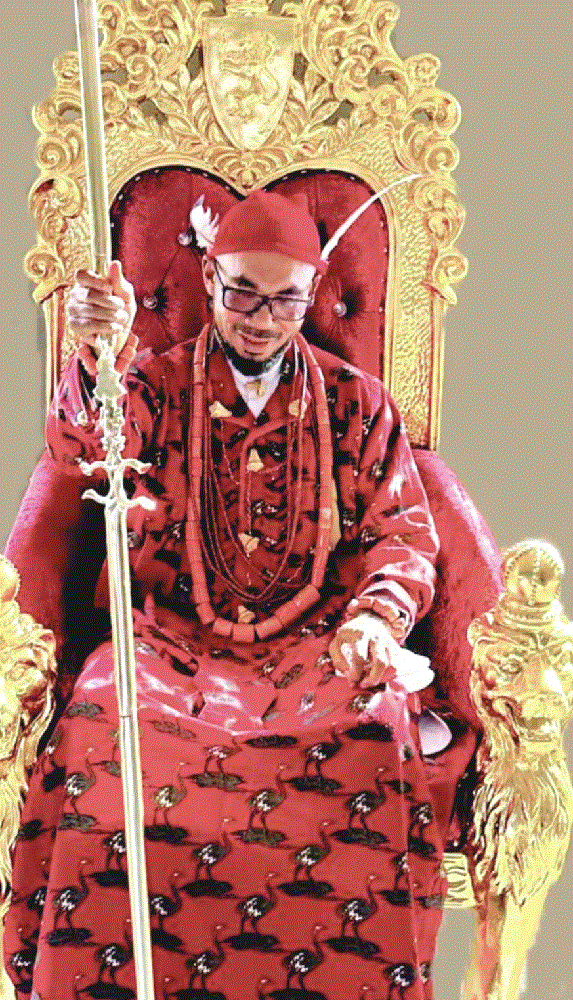
By HRM King (Dr) Suanu Baridam
Royal dress – the glittering robes, beaded crowns and elaborately embroidered capes – is a potent symbol. It marks a man as a custodian of history, a focus of ceremony and a visible link between past and present. But clothing, however magnificent, is only a surface.
What makes a traditional ruler truly great is not the costume he wears but the character he brings to his office: integrity, wisdom, humility and service.
Ceremonial regalia matters. It carries meaning: continuity with ancestors, cultural pride, a sacred role in rites and festivals. For communities that have suffered dispossession and marginalization, those symbols can be a source of dignity and unity.
Yet when we measure leadership by pageantry alone, we miss what truly sustains a people. Beautiful robes do not feed hungry families, settle disputes fairly or protect the vulnerable. A crown does not guarantee justice.
Character is the foundation of legitimate authority. A traditional ruler who is honest, courageous and consistent earns respect that outlasts any festival. Integrity means refusing to misuse power for personal gain, making decisions transparently and taking responsibility when things go wrong. Wisdom means listening as much as speaking, grounding policy in custom and law but adapting when traditions hurt people. Humility shows itself in accessibility – in chiefs who walk among their people, hear grievances and act – rather than hiding behind ceremony.
Great kings and chiefs throughout African history combined symbolic authority with moral leadership.
Their greatness came from settling disputes with equity, preserving and transmitting culture, protecting the vulnerable and negotiating on behalf of their people. In today’s world, the role is broader but the principle is the same: the trappings of office should reinforce – not replace – the ruler’s obligations.
What are the practical expectations communities have of their traditional rulers?
Justice and fairness: Traditional courts and dispute resolution should be impartial and grounded in both custom and human rights.
Stewardship of culture: Protecting language, ceremonies and heritage while allowing healthy evolution.
Service and social responsibility: Supporting education, health initiatives and economic opportunities and standing against corruption.
Guardianship of the vulnerable: Defending the rights of women, children and minorities in the community.
Collaboration with modern governance: Working with elected institutions to advance development without surrendering customary responsibilities.
Mentorship and succession planning: Preparing the next generation to lead with character, not just costume.
For African kings to live up to these expectations they must put integrity at the center of their rule. That requires concrete steps: transparent decision-making, accountability mechanisms (community councils, public hearings), training in dispute resolution and contemporary law, and open communication with youth and civil society. It also requires humility – an understanding that authority is a trust whose value is measured by service, not spectacle.
This is not a rejection of tradition. On the contrary: when clothing and ceremony accompany a ruler of strong character, they become powerful tools for social cohesion and moral example. Regalia can remind people of shared history; character makes that history worthy of remembrance.
Let African kings dress as kings, but let their conduct prove their title. Let them be custodians of culture and champions of justice. In the end, the crown is only as noble as the man who wears it. True greatness belongs to those whose lives align with the dignity their robes symbolize.
Written by
His Royal Majesty king (Dr) Suanu Timothy Yormaadam Baridam. Jp,Fcsi, Fnim,Fnis,MCI’rb. Gbenemene & Kasimene Ancient Bangha kingdom -Ogoni land. (Viii) Chairman khana Local Govt traditional rulers council. Secretary Supreme council of (FATA.). Public Relations officer-Forum of Kings, Queens, Sultans, Sheikhs, Princes and Traditional Chiefs of Africa. National Treasure African Indigenous Governance Council (AIGC)


