
By Amieyeofori Ibim
In the story of Nigeria, there are wounds that never close — wounds of silence, of soil, of souls betrayed. Among these, none bleeds more persistently than the death of Ken Saro-Wiwa and the Ogoni Nine, a stain that history keeps trying, and failing, to wash away.
Thirty years after their execution, the Nigerian state, under President Bola Ahmed Tinubu, extended a posthumous pardon to the nine men killed in 1995 under the rule of General Sani Abacha. It was framed as a gesture of healing — an attempt to close a chapter. But for many, it opened the wound again.
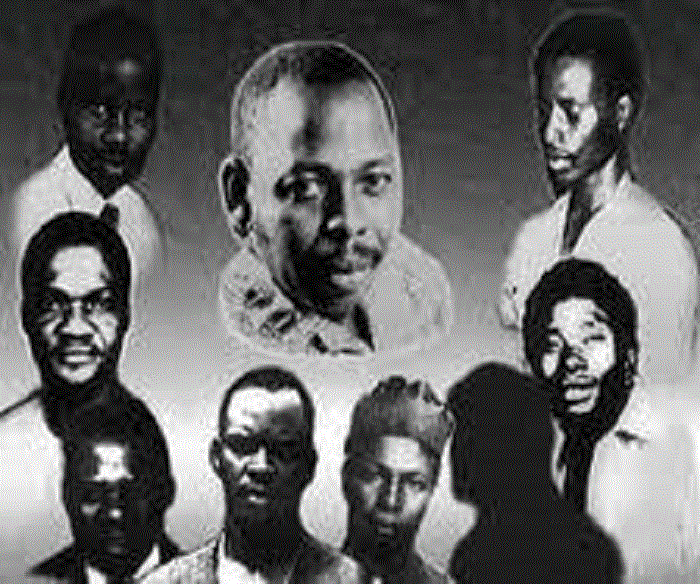
The Ogoni Nine — Ken Saro-Wiwa, Saturday Dobee, Nordu Eawo, Daniel Gbooko, Paul Levera, Felix Nuate, Baribor Bera, Barinem Kiobel, and John Kpuine — were executed by hanging after a secret military trial.
Their offense was not violence, but defiance: they had accused Shell and the Nigerian government of ecological destruction and human rights abuses in Ogoniland.
President Tinubu’s pardon came alongside those of other historical figures: Herbert Macaulay, nationalist and co-founder of the NCNC; and Major-General Mamman Vatsa, a soldier-poet executed in 1986. It was announced as part of a broad clemency exercise meant to promote reconciliation and restorative justice.
Yet, the families of the Ogoni Nine were not ready to reconcile. For them, forgiveness without truth was just another injustice wrapped in official language. Noo Saro-Wiwa, Ken’s daughter, spoke for many when she declared that a pardon implied guilt — and what her father needed was not mercy, but exoneration.
The story of their execution is not just a story of one man’s death; it is the story of a country’s capacity for cruelty. In 1995, Nigeria was in the grip of a regime that ruled through fear and silence. General Sani Abacha’s government was paranoid, intolerant, and brutal — the kind of state where the pen was a weapon more feared than the gun.
Ken Saro-Wiwa was already a celebrated writer, a television producer, and an environmental activist when he founded the Movement for the Survival of the Ogoni People (MOSOP). Through it, he mobilized his people to demand environmental justice and a fair share of the wealth drawn from their oil-soaked land.
Ogoni, a small ethnic nation in the Niger Delta, had seen decades of environmental degradation. Farmlands were charred by oil spills, rivers turned to sludge, and air thickened with gas flares. The same land that had once fed generations was now unrecognizable — a landscape of loss.
When words failed to move the oil companies and the state, Saro-Wiwa turned his pen into protest. His speeches rang like sermons; his essays struck like indictments. “The writer,” he said, “cannot be a mere storyteller in times of oppression. He must be a prophet.”
The prophecy came true in the worst possible way. In 1994, four Ogoni leaders were murdered during internal tensions fueled by agents of the state. The military swiftly accused Saro-Wiwa and eight MOSOP leaders of orchestrating the killings. It was a convenient excuse to crush a movement that had embarrassed the government and its corporate allies.
Human rights lawyer Femi Falana, who defended Saro-Wiwa, recalled that the trial was a travesty from the beginning. A “special military tribunal” was set up under the Civil Disturbances Decree — a law that stripped the accused of the right to appeal. It was less a court than a stage for predetermined guilt.
According to Falana, Shell Petroleum Development Company had been granted permission by the Nigerian state to import arms under the guise of protecting its assets. Those weapons later ended up in the hands of youths used to foment conflict in Ogoniland — a strategy of division that paved the way for military intervention.
When the divide-and-rule tactics failed, a task force led by Col. Paul Okuntimo moved in. Villages were raided, men killed, and homes burned. Women were violated. “We were under siege,” one survivor later said. “Our crime was asking to live on our own land.”
In that atmosphere of terror, Saro-Wiwa and his colleagues were arrested. Even before the trial began, the Rivers State military governor, Col. Dauda Komo, publicly declared them responsible for the killings — a statement that erased the presumption of innocence and scripted the outcome.
Evidence favourable to the accused was dismissed; defense witnesses were intimidated. The prosecutors withdrew at one point, declaring the evidence too weak. But the junta insisted: someone had to die to preserve the illusion of order. The tribunal delivered its verdict swiftly — guilty on all counts.
Under the law, the Provisional Ruling Council was supposed to review and confirm the death sentences after examining the trial records. But as Falana later revealed, the executions were carried out before the tribunal even completed its record. It was murder masked as justice.
On November 10, 1995, Ken Saro-Wiwa and his comrades were led to the gallows. Witnesses said he struggled, shouting defiantly: “Lord, take my soul, but the struggle continues.” His words became a prophecy that still burns through the oil-slicked swamps of Ogoni.
The international community reacted with outrage. Nigeria was suspended from the Commonwealth of Nations, and world leaders condemned the execution as barbaric. But inside the country, silence reigned — the kind born not of peace, but of fear.
Decades passed. Democracy returned, oil still flowed, and the creeks remained poisoned. The Ogoni people carried on, their land scarred but their spirit unbroken. Every year, they gathered to honour their martyrs — to remember that truth once died on the gallows in Port Harcourt.
When Tinubu’s administration announced the posthumous pardon in 2025, it was hailed by some as an act of moral courage. The state, it seemed, was finally acknowledging the injustice of its past. The Ogoni Nine were grouped with other figures — some victims, some convicts — in a gesture meant to promote “restorative justice.”
The gesture was symbolic, but symbolism can be dangerous when it stands in for substance. To many, a pardon suggested that the state still saw them as guilty men forgiven, not innocent men wronged.
Noo Saro-Wiwa and human rights advocates rejected the gesture outright. What they wanted was a full judicial review — a retrial that would declare, in law, what history already knew: that the Ogoni Nine were innocent. Anything less, they said, would be a continuation of the injustice that killed them.
For the Nigerian government, the pardon may have been a political gesture of unity. But for the Ogoni, unity cannot grow from unacknowledged pain. A nation that cannot face its cruelty cannot claim to have healed.
The cruelty, after all, was not only in the hangman’s noose. It was in the collusion between state and corporation, in the deliberate poisoning of a people’s land, in the decades of silence that followed the screams of the executed.
The Niger Delta remains a monument to that cruelty. Oil still bubbles beneath ruined farms. Flares still burn through the night. The children of Ogoni still inhale what their fathers fought against — and died for.
Yet, in this landscape of decay, the memory of Ken Saro-Wiwa endures like a stubborn flame. His name is spoken in classrooms, in environmental courts, in the corridors of NGOs. His words have outlived his killers.
“I am a man of ideas,” he once wrote, “and you cannot kill ideas.” In that sense, the hangman failed. The rope may have stilled his breath, but not his message.
The pardon of 2025, imperfect as it was, forces Nigeria to look again at itself — to confront how easily it confuses strength with cruelty, and how often it sacrifices justice for convenience.
What Ken Saro-Wiwa and the Ogoni Nine taught, ultimately, is that a nation’s greatness is not measured by its oil wells or its military might, but by its capacity for truth.
And until Nigeria finds the courage to say — not “we forgive them,” but “we wronged them” — the ghosts of Ogoniland will keep whispering through the mangroves, asking, still, for justice.
Amieyeofori Ibim is a seasoned Journalist, political analyst and public affairs commentator.
08112095925