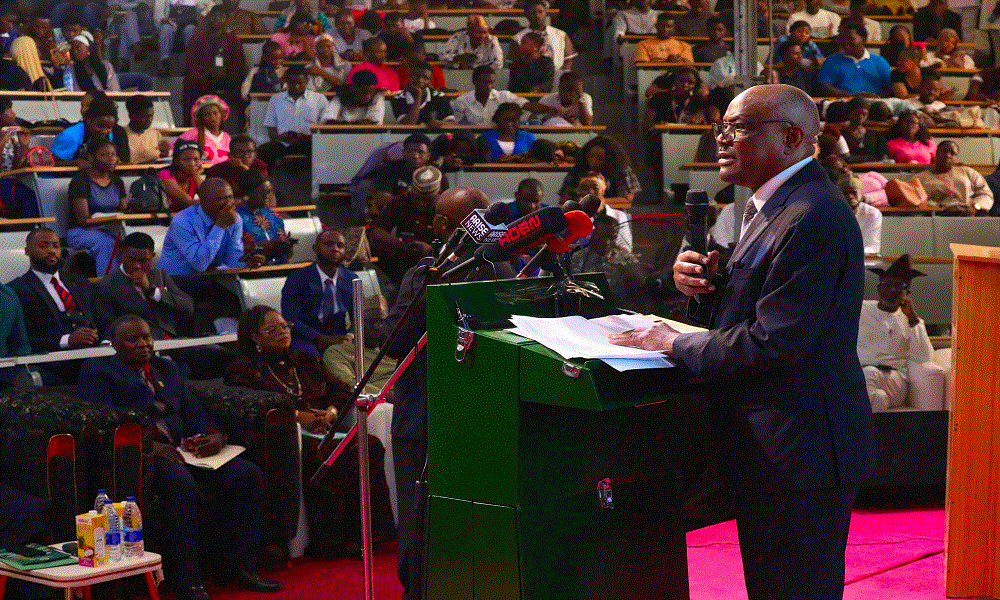


President Bola Ahmed Tinubu has delivered a firm and cautionary message to Nigeria’s judiciary, warning that the nation’s democratic foundation is at risk when public confidence in the courts wanes.
Speaking at the opening of the 2025 All Nigerian Judges’ Conference of the Superior Courts at the Andrews Otutu Obaseki Auditorium of the National Judicial Institute in Abuja, President Tinubu emphasised that “justice must never be for sale”, stressing that integrity, impartiality, and accountability are the bedrock of a functional democracy.
Addressing a gathering of Nigeria’s senior judges, the President noted that the judiciary has historically served as the stabilising force during periods of national uncertainty. He lauded judges for their courage in restraining tyranny, preserving constitutional order, and amplifying the voice of justice above societal divisions.
“Whenever Nigeria has faced moments of uncertainty, history has shown that it is the Judiciary that has remained steadfast,” Tinubu said. “It is through the courage and integrity of our judges that democracy has been preserved, the rule of law protected, and citizens’ rights safeguarded.”
However, the President acknowledged that public perception of the judicial system has often been unfavourable, citing widespread frustration over delays, concerns about the integrity of judicial processes, and limited access to justice for ordinary Nigerians.
“These perceptions, whether wholly justified or not, cannot be ignored,” he said. “Justice exists for the people. Their confidence in the judicial process is the foundation of national stability. When citizens believe the courts are influenced by money or power, the very essence of democracy is undermined.”
President Tinubu used the occasion to reaffirm his administration’s commitment to strengthening the judiciary through tangible reforms. He highlighted ongoing efforts to modernise court infrastructure, expand digital case management systems, and provide well-equipped, secure courtrooms that promote transparency and efficiency.
“Support for the Judiciary must be real and substantive, not merely symbolic,” he stressed. “Our courts can no longer be places where cases linger for years. Justice must be swift, transparent, and accessible. Modern infrastructure and digitisation are essential, but they must be accompanied by unwavering integrity.”
He further warned that without the moral courage of judges, reforms would fail. “The true strength of the Judiciary lies not in buildings or technology, but in the men and women who interpret and apply the law,” he said. “Justice must never be compromised, and the Bench must never become a sanctuary for compromise. Corruption in any arm of government weakens the nation, but corruption in the Judiciary destroys it at its very core.”
The President urged judges to take a proactive role in confronting systemic challenges. He called on them to ask difficult questions during the conference: How can case backlogs be reduced? How can discipline within the Judiciary be strengthened? How can justice become more affordable and accessible to the poor, the vulnerable, and the voiceless?
“Your deliberations must be bold, practical, and actionable,” Tinubu said. “The Judiciary is not an end in itself. It is an instrument of justice for the people. A fearless, transparent, and principled judiciary is the greatest safeguard of freedom. Conversely, a slow, compromised, or disconnected judiciary is democracy’s greatest threat.”
President Tinubu also praised the role of the National Judicial Institute (NJI) in promoting continuous learning, training, and professional development for judges. He stressed that judges must evolve alongside the law to meet contemporary challenges, shaping it in line with constitutional values and the expectations of the citizenry.
Concluding his address, Tinubu reminded the judiciary of the profound responsibility they hold as custodians of the nation’s moral conscience. “You hold the power to ensure that no citizen is too weak to be heard, and no authority too powerful to be restrained by law,” he said. “Let the chapters we write today be remembered for integrity, courage, and fidelity to the rule of law.”
He officially declared the 2025 All Nigerian Judges’ Conference open, urging delegates to engage deeply in discussions, propose meaningful reforms, and commit to strengthening the judiciary’s independence and credibility. “May your deliberations be fruitful, your resolutions transformative, and may the Judiciary continue to stand as the conscience of our nation,” he concluded.