
By Amieyeofori Ibim
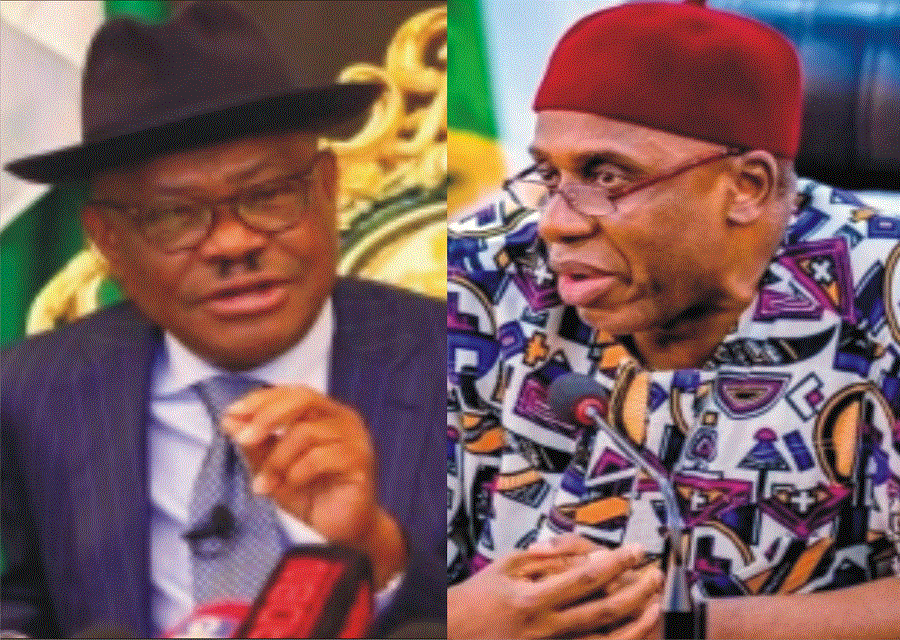
As Nigeria marches toward the 2027 general elections, Rivers State finds itself once again caught in a political tug-of-war between two familiar adversaries: Nyesom Wike and Rotimi Amaechi.
For over a decade, these two political giants have dominated the state’s landscape—first as allies, now as bitter rivals. But while they spar for control, it’s the people of Rivers who continue to suffer.
This renewed feud isn’t about policy or ideology. It’s about ego. It’s about control. And it has become a never-ending cycle of personal vendettas masked as political contests.
What ought to be a democratic debate over the future of Rivers has instead devolved into a toxic rivalry that threatens to suffocate the state’s progress.
Both men are seasoned politicians. Wike, currently the Minister of the Federal Capital Territory, is known for his combative style and raw political energy.
Amaechi, a former Minister of Transportation and ex-governor, is equally entrenched in the system.
Yet despite their vast experience and influence, neither has demonstrated a lasting commitment to lifting the state beyond their personal ambitions.
Rivers State is one of Nigeria’s richest in resources, with vast oil deposits and an industrious population. But it continues to underperform in development metrics.
Roads remain neglected, unemployment festers, and industrial growth is stunted. The endless political drama has left little room for real governance or long-term planning.
The origin of the Wike-Amaechi rivalry is rooted in betrayal and shifting loyalties.
close allies within the same political structure, their fallout was both personal and explosive.
What began as a power struggle within the People’s Democratic Party has since extended across party lines and spilled into national politics, dragging Rivers along as collateral damage.
Elections in Rivers have become synonymous with tension, violence, and fear.
Thuggery, voter suppression, and inflammatory rhetoric have become recurring features.
At the center of it all lies the ambition of these two men, unwilling to step aside or work together for the greater good.
This rivalry has also created a political culture where loyalty trumps competence.
Public servants and local leaders are often judged not by their performance, but by their allegiance to either Wike or Amaechi.
In such an environment, innovation and merit are drowned out by sycophancy and suspicion.
What’s more concerning is that both men have been richly rewarded by the political system. Amaechi rose through the ranks as Speaker, Governor, and Minister.
Wike has followed a similar path, culminating in his current federal appointment.
Their political careers have been built on the very system they now hold hostage.
Yet despite this privilege, neither has managed to forge a new path for the state. The same issues that plagued Rivers a decade ago—poor infrastructure, youth disillusionment, insecurity—remain unresolved.
The opportunity to leave a legacy of development has been traded for a legacy of division.
More recently, Wike’s combative defense of the Tinubu administration and his sharp-tongued rebukes of critics have done little to foster unity.
Instead of elevating political discourse, he often inflames it, turning governance into a series of press battles and partisan jabs. Amaechi, on his part, maintains a quieter profile but remains no less determined to reclaim influence.
This is not the kind of leadership Rivers needs. The people deserve leaders who prioritize collective progress over personal point-scoring.
They need builders, not brawlers. Strategists, not strongmen. It is time to demand better from those who seek to govern.
As 2027 draws nearer, Rivers people must resist the temptation to be used once more as pawns in a political chess match.
Loyalty to individuals must give way to loyalty to principles: good governance, peace, and development. The next election must not be a rerun of old grudges—it must be a reset.
Rivers youth, in particular, must rise to this moment.
They have been the most used—and most abused—in the power games of the past. Now is the time to organize, mobilize, and demand a new kind of politics.
One that doesn’t weaponize their hunger but empowers their future.
Let Wike and Amaechi settle their personal quarrels privately. The destiny of Rivers cannot be perpetually tied to their ambitions.
The state belongs to its people, and it is they who must reclaim it, redefine it, and reimagine it.
The soul of Rivers State does not belong to any one man.
It belongs to the people. And it’s time they chose a future free of the shadows of the past. Amieyeofori Ibim is a PH based Journalist, political analyst and public affairs commentator