

By Bisi Olawunmi
President Bola Tinubu is currently engaged in a high-powered political-sociological cum economic engineering in Ogoni land with a view to enhancing the peace process and consequently allowing the oil to flow again in Ogoni land, after 30 years of violent agitation shut the wells.
The latest gambit in the peace process is the granting of pardon to the Ogoni Nine convicted and executed on November 10, 1995, for incitement and murder of the Ogoni Four on May 21, 1994, as reported in the media, including The Nation and The Punch, on Friday, October 10, 2025.
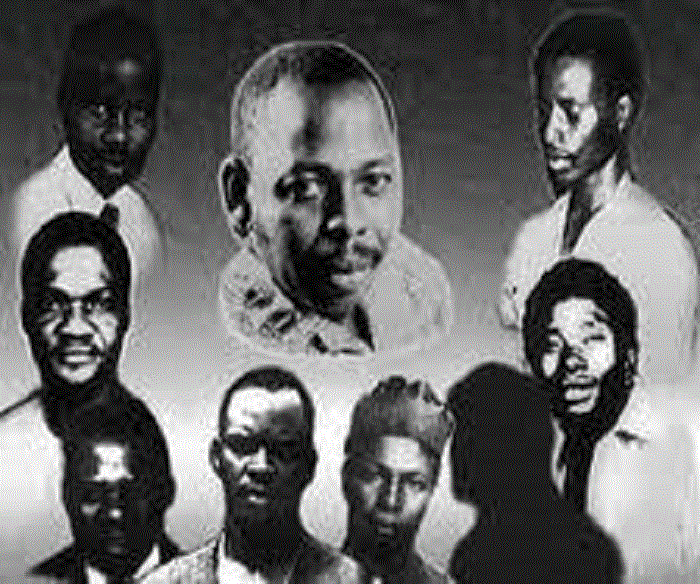
The pardon is the latest effort to placate the militant wing of the Movement for the Survival of Ogoni People led by writer, environmental activist, Ken Saro-Wiwa, who had, early in September 2025, been given national honours by President Tinubu. The Ogoni Nine were Ken Saro-Wiwa, Dr Barinem Kiobel, Saturday Dobee, Nordu Eawo, Daniel Gbooko, Paul Levera, Felix Nuate, Baribor Bera and John Kpuine. These national honours for the Ogoni Nine had sparked criticism of the Federal Government for ignoring the Ogoni Four, victims of brazen, broad daylight murder.
Following the backlash, Tinubu, on Wednesday, September 24, 2025, bestowed the national honour of Commander of the Order of the Niger on the Ogoni Four, the four prominent Ogoni leaders murdered at the alleged incitement of Ken Saro-Wiwa. The Ogoni Four were Chief Albert Badey, Chief Edward Kobani, Chief Theophilus Orage and Chief Samuel Orage. They were among the founding leaders of the Movement for the Survival of Ogoni People, who brought Ken Saro-Wiwa into the organisation as publicity officer because of his media connections.
So, even if the honour to the Ogoni Four is considered an afterthought, President Tinubu still deserves some commendation for allowing reason and pragmatism to eventually prevail over blackmail. But let Tinubu beware of banana peels in the treacherous terrain of Ogoniland, where the militants continue to hold sway, given how they successfully blindsided the Tinubu Presidency into initially forgetting the Ogoni Four. The latest pardon, seen as continuing appeasement of the Ken Saro-Wiwa disciples, is more likely to heighten the deep-rooted, seething anger in Ogoniland between the two divides, a situation akin to a simmering volcano that could erupt into fireballs.
The tragedy of the Ogoni 13, a festering sore that refuses to heal, has deeply polarised the Ogoni community in Rivers State and, to some extent, the larger Nigerian society on the matter of guilt or otherwise of the Ogoni Nine, with the pro Ken Saro-Wiwa group dominating the public narrative. The poser here is: How did the Tinubu Presidency get persuaded – or railroaded – into granting that initial faux pas honour to the Ogoni Nine?
The Ken Saro-Wiwa saga is a classic example of how a well-oiled propaganda machinery can easily sway the unwary and the intellectually indolent, because propaganda appeals to emotion and not to reason. Details of the crime were willfully ignored by many, as if being an activist is a licence for murder.
I will start on a personal note. I had an opportunity to meet Ken Saro-Wiwa when I was at the News Agency of Nigeria in Lagos. His fellow Ogoni, James Nally, a staff member of NAN then, brought him to the NAN office. What struck me first was the disproportionate bigness of his head! It was like a character from ‘Igbo Irunmole’! (forest of the deities). He raged about Ogoni marginalisation. He came across as an Ogoni irredentist, which manifests in one of his books, The Darkling Plain, where he noted the Ogoni as the only honest tribe in Nigeria. Nally, his kinsman, also had this sense of persecution in the office and of the Ogoni as an ethnic group. He calls me ‘Oga Bisi’, and I was about the only one he related well to.
The other personal note was on the day the Ogoni Nine were executed, November 10, 1995, when a NAN reporter in Port Harcourt filed the story to Lagos. As the assistant editor-in-chief, I was the most senior staff member on duty. When I broke the story in the newsroom, there was bedlam; the office was thrown into pandemonium, with many saying we should not publish the story for fear of repercussions. Others were cursing Abacha. I reminded the agitated staff members that four leaders of Ogoni were murdered in broad daylight. That statement further enraged some staff members, and one of them even started moving menacingly towards me. I dared him to get physical and that it would be his last day in NAN. He beat a fast retreat. I then reminded the staff members present that it was such an inclination to violence that got the Ogoni Nine into trouble. I read the draft of the story to the Editor-in-Chief, Mr Dave Igiewe, at home, and he gave clearance to publish. There was an instant global reaction, with sanctions slammed on Nigeria. Staff members who feared the Abacha military government would clamp down on NAN were surprised that nothing of such happened. We were professional in writing the story – no adjectives, no opinion, no insinuations, no embellishments, just the bare facts.
Most times, it is when journalists fail to adhere to ethical journalism practices that they run into trouble with the government.
Thirdly, a granddaughter of Chief Kobani, Zigalobari Peace Kobani, was one of my students at the Department of Mass Communication, Adeleke University, Ede (September 2019- July 2023). She was an ever-smiling, brilliant student, graduating with Second Class (Upper) – CGPA 4.15 of 5.00 max.
The tragic journey for the Ogoni 13 began on May 21, 1994, when a murderous mob of Ogoni youths descended on prominent Ogoni leaders gathered in the palace of Gbenemene, the traditional ruler of Gokana, to celebrate one of their own. According to reports, security agents had escorted Saro-Wiwa out of the town earlier in the day, given the restiveness of youths who were ardent disciples of the environmental activist. As he was being led out, he was reported to have told the youths that their oppressors were meeting to share money from the Shell oil company and from the government, describing them as vultures. In Ogoniland, the prevalent notion was that once Saro-Wiwa tagged anyone ‘vulture’, it amounted to a death sentence. Some elders were said to have gone to Kiobel, one of the Ogoni Nine, to come to the palace and calm the mob. This commissioner in government was reported to have told the emissaries that he could not counter Ken Saro-Wiwa’s directive.
At that point, the mob went berserk, broke into the gathering and unleashed mayhem. As narrated by Suage Badey, son of Albert Badey, one of the Ogoni Four, the father was said to have escaped from the venue and ran to hide in the house of a woman. However, when the mob threatened to lynch the woman, he had to come out of hiding, and the mob pounced on him. The mob got the other three.
In a horrific display of bestiality and cannibalism, the pro-Ken Saro-Wiwa mob dismembered those four prominent fellow Ogonis and the pieces of their bodies were carted away such that there was nothing for the children to bury. And this happened in broad daylight. The murderers were natives, and the people know themselves.
Why Ogoniland remains on a tinder box, which should be tended with great caution, is the demand of the Ken Saro-Wiwa group for the exoneration of the Ogoni Nine, while the pro-Ogoni Four are demanding the bodies, or even the bones, of the four Ogoni chiefs to bury and a public apology from MOSOP to give them closure. However, with campaigners aggressively seeking that the Ogoni Nine should be exonerated of the killing of the Ogoni Four, is it then that the Ogoni Four were killed by ghosts? The pro-Ogoni Nine demand is symptomatic of the pervasive impunity in the country, where criminal elements, including murderers, have developed the effrontery to claim immunity from justice. It is that bad, and reason why violence is literally drowning the country.
The media, local and international, have been complicit in the Ogoni tragedy by their morbid partisanship in the saturation reportage of Ken Saro-Wiwa, apparently inducing in him a sense of invincibility that ultimately led him on to the path of perdition. There are a few, though, who like Arise TV host Charles Aniagolu, have pondered whether the fact of Ken Saro-Wiwa’s trial and execution under Gen. Sani Abacha was a factor in deodorising the image of the environmental activist and downplaying the crime he was accused of. But the media is expected to abide by the accuracy and fairness doctrine. Can the Nigerian press claim to have been accurate and fair to the Ogoni Four in their news reports and analyses of the Ogoni Saga all these years? What is more, virtually all media reports about the Ogoni Nine are discriminatory – it is usually Saro-Wiwa and eight others. So, the eight others are non-persons?
Successive governments have been complicit in environmental degradation, especially in oil-producing areas of the country, a laxity that brought Ken Saro-Wiwa to the limelight in his agitation for remedial measures in his polluted homeland. Governments would rather cohort with exploitative multinational oil companies than protect the environment for the good of the people. To that extent, Saro-Wiwa was engaged in a noble cause. The Ogoni Four were similarly engaged in agitation for environmental cleanup of Ogoniland. They only differ in strategies, with the Ogoni leaders preferring the non-violent approach as against Ken Saro-Wiwa’s militancy. The point must be made, and strongly too, that disagreement in strategy should not be a licence for murder.
I have written two newspaper articles on the Ogoni crisis, the first titled “Ogoni Four – Remembering the unsung martyrs”, which was published in the Guardian, June 5, 2005, and New Age on June 13, 2005. The second, titled “Between Gambari and Ken Saro-Wiwa: Who is the villain?” was published in The Guardian on May 25, 2020; Daily Independent, May 22, 2020 and Peoples Daily on May 22, 2020, where I took exception to Ken Saro-Wiwa propaganda ensemble vilifying Prof. Ibrahim Gambari for defending the activist’s execution at the United Nations. In the two articles, the central point I articulated was that it is wrong to canonise someone found guilty of murder.
The founding President of MOSOP, Dr Garrick Barilee Leton, got ostracised from Ogoniland when Saro-Wiwa and his militant youths took over the organisation. It was significant that Leton, a former Minister of Education, testified against Saro-Wiwa at the military tribunal that Saro-Wiwa was consumed by lust for power to be in complete control of MOSOP. Chief Edward Kobani, one of the Ogoni Four, was a former vice president of MOSOP. Chief Sam Orage was married to the elder sister of Saro-Wiwa’s wife. In one of his letters to an ally, one Majella, dated July 30, 1994, while in detention, Saro-Wiwa had noted his and Ogoni’s tragic circumstances: “I haven’t heard from the children and that’s worrying … And the family has been wracked by illness and tragedy. My first son underwent heart surgery, and the Orages who were murdered were in-laws. Sam Orage brought up my wife (he’s married to her elder sister). So, the tragedy grows.” The Ogoni tragedy grows, indeed. Today, the division-racked Ogoniland has three claimants as president of MOSOP.
Is President Tinubu genuinely interested in restoring peace in Ogoni land, or is he primarily motivated by the prospects of oil money from Ogoniland? Suage Badey, son of murder victim, Chief Albert Badey, while appearing Arise TV programme, Prime Time, on October 1, 2025, spoke of “palpable tension” in Ogoniland given the subsisting deep divisions while Kenneth Kobani, son of Chief Edward Kobani at the 2025 memorial service for the Ogoni Four, indicated the resolve of the families of their parents for the bodies and penance. President Tinubu seems to have just woken up to the lost revenue from the Ogoni shutdown of the oil wells and may be tempted to rush into the terrain, with his cash-cow boy at the FIRS, Zacch Adedeji, in tow. However, Tinubu is better advised not to present as if he has been captured by the Saro-Wiwa lobby and is being seen as implementing the agenda of the militants. An obvious partisan inclination by Tinubu will generate resentment from other sidelined stakeholders in Ogoniland. That cannot foster the peace process. He should be an impartial conciliator, a healer. An emerging trend where the state usually surrenders to militancy is one of the reasons Nigeria today is prostrating before terrorists, bandits, kidnappers, ritualists and sundry violent agitators.
Dr Olawunmi, Senior Lecturer, Department of Mass Communication, Adeleke University, Ede, Osun State, a former Washington Correspondent of the News Agency of Nigeria and Fellow, Nigerian Guild of Editors, writes via olawunmibisi@yahoo.com


