
The International Agency for Research on Cancer (IARC), a specialised arm of the World Health Organization, has commenced a comprehensive health impact study in Ogoniland to determine the correlation between decades of oil exploration, environmental pollution and the health status of the Ogoni people.
The study, which forms part of the recommendations of the United Nations Environment Programme report on the environmental assessment of Ogoniland, is being carried out in collaboration with the Hydrocarbon Pollution Remediation Project. It is expected to run for approximately two and a half years.
HYPREP Project Coordinator, Professor Nenibarini Zabbey, had earlier disclosed that the agency commissioned WHO to undertake the study as part of the ongoing implementation of the UNEP report on the clean-up and remediation of impacted sites in Ogoniland.
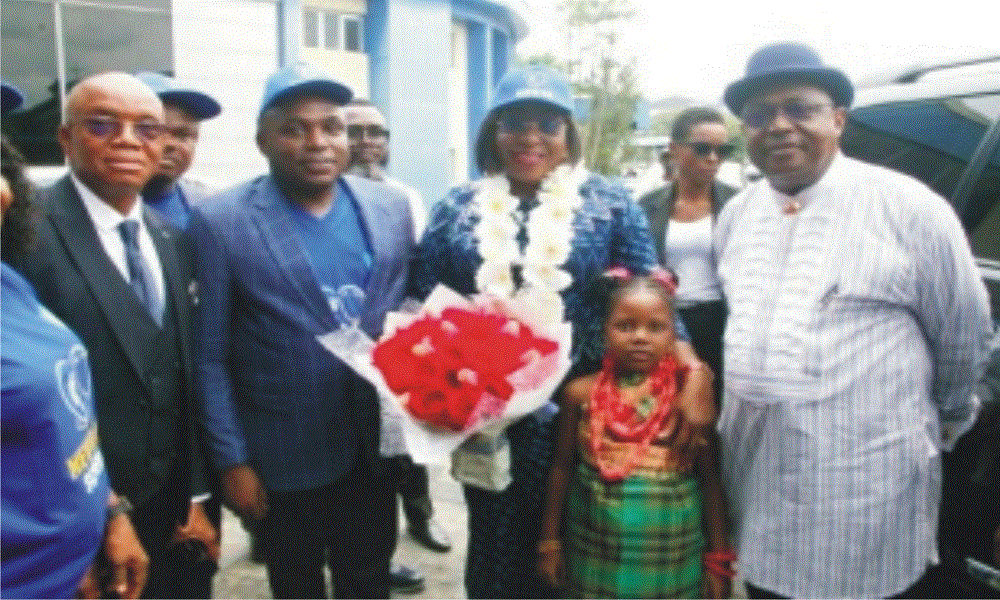
Speaking during a visit to traditional rulers in Gokana and Tai Local Government Areas, Lead Scientist at IARC, Ann Olysson, said the health assessment was originally recommended by UNEP and that her agency was selected based on its international recognition and expertise in conducting large-scale epidemiological and exposure studies.
“We are about, with your permission, to begin a study that was originally recommended by the UNEP study,” Olysson stated.
“We are in collaboration with HYPREP to conduct the test and the choice of our agency to conduct the study is in international recognition for this type of study.”
Also speaking, Mr. Michael Cowing, who served as UNEP Project Coordinator and Lead Researcher between 2009 and 2011 during the production of the Ogoniland environmental assessment report, recalled that a key recommendation of the report was a comprehensive health evaluation of the population.
Cowing explained that preliminary desk work, mapping and research commenced in mid-2025, while fieldwork is now set to begin across selected communities.
The study will involve about 4,000 participants drawn from both heavily impacted and non-impacted communities to enable comparative analysis.
“We know where the epicentres of contamination are, we’ve plotted the communities over those maps, and they will be the impacted communities where we will focus the study,” he said.
“But we are also doing studies in unimpacted communities so we can compare the different results.”
He added that the research would examine occupational exposure patterns, including farming, fishing, sand mining and artisanal refining, in order to establish varying levels of hydrocarbon exposure and associated health outcomes.
Professor Iyenemi Kakulu of Rivers State University, who is part of the research team, noted that participants would be scientifically selected and engaged through community leadership structures.
She said the team would seek voluntary consent from individuals, explaining that data collection would include interviews and limited biological sampling such as blood and urine for laboratory analysis.
“We are here on a friendly note to ask for your support, to grant us access into your kingdom, so that we can roam around and talk to your people,” Kakulu said, emphasising the need for collaboration with traditional institutions to ensure smooth implementation.
Representing the HYPREP Project Coordinator during the engagement, Director of Technical Services, Damian Paul-Aguiyi, appealed for security, sensitisation and cooperation from the host communities.
He stressed that the study was not a contracted commercial exercise but a scientific intervention aimed at strengthening evidence-based remediation and public health planning.
Responding, the Gbenemene of Tai Kingdom, King Samuel Nnee, assured the delegation of the full support of his people, describing the initiative as critical to safeguarding public health.
He observed that life expectancy in Ogoni communities was higher before the advent of oil exploration and expressed optimism that the study would provide clarity on longstanding health concerns. Similarly, the Gberemene of Gokana Kingdom, King Festus Paago Bagia, represented by Mene Stephen Kobani of Goi community, welcomed the initiative and pledged cooperation.