
By Jerry Needam
The Minister of the Federal Capital Territory (FCT), Nyesom Wike, has declared that Nigeria’s democracy must transcend periodic elections and begin to produce tangible development that directly impacts citizens’ lives.
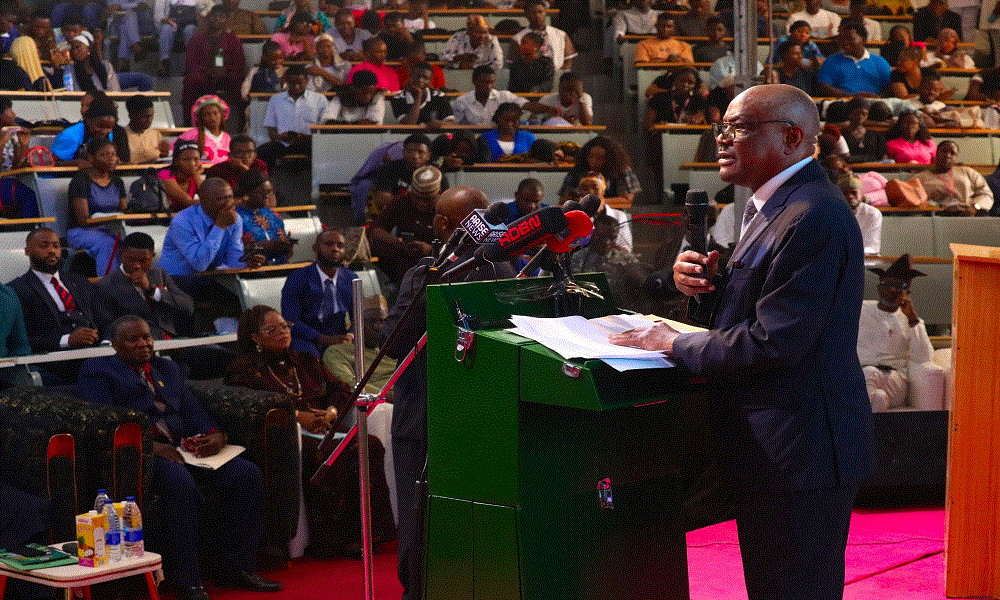
Wike made this assertion on Tuesday while delivering a Distinguished Personality Lecture at the Faculty of Social Sciences Auditorium of the University of Abuja.
The lecture was titled: “The Impact of Political Leadership on Infrastructural Development in Nigeria: Between Dividends of Democracy and Good Governance.”
Addressing scholars, students, policymakers, and dignitaries, the FCT Minister stressed that democracy should not be reduced to a mere electoral ritual.
“Democracy must not remain a ritual,” Wike declared. “It must deliver roads that work, schools that inspire, hospitals that heal, and cities that dignify human life.
Infrastructure is political education cast in concrete and steel.
Wike noted that although Nigeria has practiced uninterrupted democracy since 1999, the true legitimacy of the system lies in measurable improvements in the quality of life of citizens.
According to him, democracy earns credibility not only through elections but through accountability, transparency, and effective service delivery.
Quoting democracy scholar Larry Diamond and referencing literary icon Chinua Achebe, Wike argued that Nigeria’s developmental setbacks are largely consequences of leadership failures rather than absence of ideas or resources.
“Nations are not built by resources alone,” he emphasized.
“They are built by the quality of leadership that gives direction and purpose to those resources.”
Wike also commended President Bola Ahmed Tinubu for what he described as bold reforms, particularly the removal of fuel subsidy and structural economic adjustments.
He acknowledged that while such measures may impose short-term hardship, they demonstrate leadership willing to prioritize long-term national stability over immediate political gain.
“Leadership is about making difficult decisions in the interest of future generations,” he stated.
Abuja as a Model
Highlighting developments in the FCT since 2023, Wike described Abuja as a “living laboratory” of democratic governance.
He cited accelerated road construction, revival of abandoned projects, strict enforcement of urban planning regulations, and renewed infrastructural investments as evidence that purposeful leadership produces visible dividends.
“Abuja is not merely a city,” he said. “It is a national statement. How we build and maintain it reflects the seriousness of our democracy.”
He stressed that infrastructure should never be viewed as political patronage but as a fundamental right of citizens.
Wike further underscored the role of universities in strengthening democracy, urging institutions like the University of Abuja to deepen political education and promote civic responsibility.
“A nation that neglects political education prepares the ground for democratic decay,” he warned.
Concluding his address, Wike called for synergy between leadership and followership, insisting that national transformation requires shared commitment.
“History reminds us that power is fleeting, but legacy endures,” he said. “Leaders are remembered not for offices occupied, but for lives transformed.”
He urged Nigerians to work toward a democracy that delivers genuine dividends through ethical governance and inclusive development.
“Democracy must deepen. Governance must mature. Nigeria must rise to her full potential.”
The lecture was part of the Faculty of Social Sciences’ Distinguished Personality Lecture Series, designed to promote intellectual engagement on democratic consolidation and national development.
The lecture was broadcast live and monitored by the National Network Newspaper, Port Harcourt.