
FATA Secretary, King Baridam, Rivers State Council of Traditional Rulers Take Joint Position On Land Governance

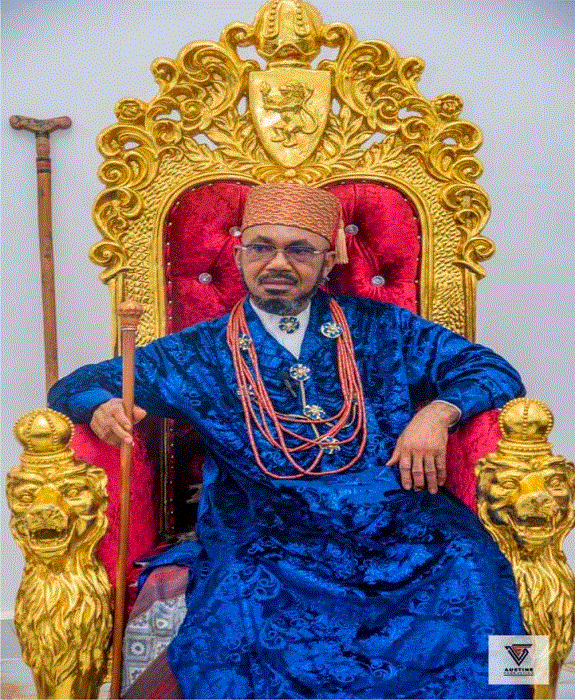
In a joint call to action, His Royal Majesty King (Dr.) Suanu T.Y. Baridam, Secretary, Supreme Council of the Forum of African Traditional Authorities (FATA), Chairman, Khana Traditional Council (Ogoni land), Permanent Member, South-South Monarchs and Member, Rivers State Council of Traditional Rulers announced a unified policy position and detailed programme to improve Nigeria’s land governance framework by better aligning customary custodianship and statutory systems.
Addressing customary leaders and government officials, King Baridam, who is also a public sector development professional and traditional herbalist, said: “As custodians of our land and communities, our ancestors bequeathed us more than an identity; they left us with an obligation to serve.
By embracing our role as trustees for future generations and forging stronger partnerships with government and civil society, we can play a critical role in addressing some of Nigeria’s most intractable land challenges”.
As a representative of traditional institutions at community, state, regional and national levels, His Majesty detailed a 10-point programme to be implemented and scaled across the state of Rivers and FATA’s sub-regional and national networks:
- Institutionalise Customary Land Secretariats (CLS)
Establish community-managed CLS to maintain paper and digital ledgers of allocations, transfers and customary rights; make allocations public and link records with state land registries to avoid multiple sales.
- Lead participatory mapping and documentation
Convene community mapping exercises to demarcate land boundaries, sacred sites and customary conservation areas; validate and digitise maps for integration into state spatial planning.
- Promote legal harmonisation at state level
Advocate for state protocols that recognise CLS records as admissible evidence in land claims and formally define customary authorities’ roles in land allocation, verification and mediation with clear referral paths to the judiciary.
- Advance transparency, grievance redress and oversight
Require public posting of allocations and transfers, accessible grievance mechanisms and independent ombuds arrangements, complemented by civic education and community monitors.
- Champion inclusion of women, queen mothers and youth
Mandate meaningful representation in CLS, joint titling pathways and targeted capacity programmes to ensure substantive participation and equitable access to land.
- Build capacity and professionalise customary institutions
Partner with universities and technical institutes to deliver certified short courses in land law, mediation, record keeping and ICT; train youth registrars and geospatial technicians.
- Pilot community economic models while retaining custodial ownership
Test community land trusts, lease-to-invest frameworks and benefit-sharing arrangements in Ogoni and neighbouring communities to ensure fair returns and infrastructure financing.
- Integrate customary stewardship into environmental policy
Map and protect customary conservation areas; coordinate agroforestry, soil conservation and Payments for Ecosystem Services (PES) initiatives linked to climate finance.
- Safeguard against abuse and corruption
Promote mandatory disclosure, independent grievance redress, judicial oversight and sanctions for corrupt conduct to protect rights and ensure accountability.
- Promote evidence-based scaling and monitoring
Implement phased pilots across peri-urban, rural and resource-affected zones, with independent evaluation and public dashboards to guide scaling and policy adoption.
The proposed measures seek to address persistent challenges in Nigeria’s land sector: undocumented customary rights, multiple land sales, exclusion of women and youth, environmental degradation in resource-impacted areas and overloaded courts. Successful implementation is expected to:
Strengthen tenure security and unlock access to credit and investment for millions;
Reduce land disputes and lower litigation costs through hybrid dispute resolution systems;
Enable communities to capture value from development while retaining custodial ownership;
Improve environmental stewardship and enhance climate resilience;
Promote social inclusion, particularly for women and youth.
His Majesty confirmed plans to mobilise blended funding combining state budget allocations, donor technical support and ethical public-private partnerships.
Academic institutions, civil society, anti-corruption bodies and the media will be engaged for training, monitoring and transparency.
“As custodians, we will lead by example. But government, development partners, academia and civil society must join us.
Together we can transform land from a source of conflict into a foundation for shared prosperity, justice and environmental resilience for Ogoni, Rivers State and all of Nigeria”, King Baridam said.
For further information, partnership enquiries or to request interviews, contact:
His Royal Majesty King (Dr.) Suanu T.Y. Baridam
Secretary, Supreme Council, Forum of African Traditional Authorities (FATA)
Chairman, Khana Traditional Council (Ogoni land)
Permanent Member, South-South Monarchs Member, Rivers State Council of Traditional Rulers


