“It’s Ogoni Blood, Not Govt Money” – Rights Activist Akpobari Slams Reps Over HYPREP Funds

The controversy surrounding the Ogoni Cleanup Project has intensified as the House of Representatives, the Hydrocarbon Pollution Remediation Project (HYPREP), and environmental activist Akpobari Celestine clash over accountability, transparency, and jurisdiction in managing the cleanup funds.
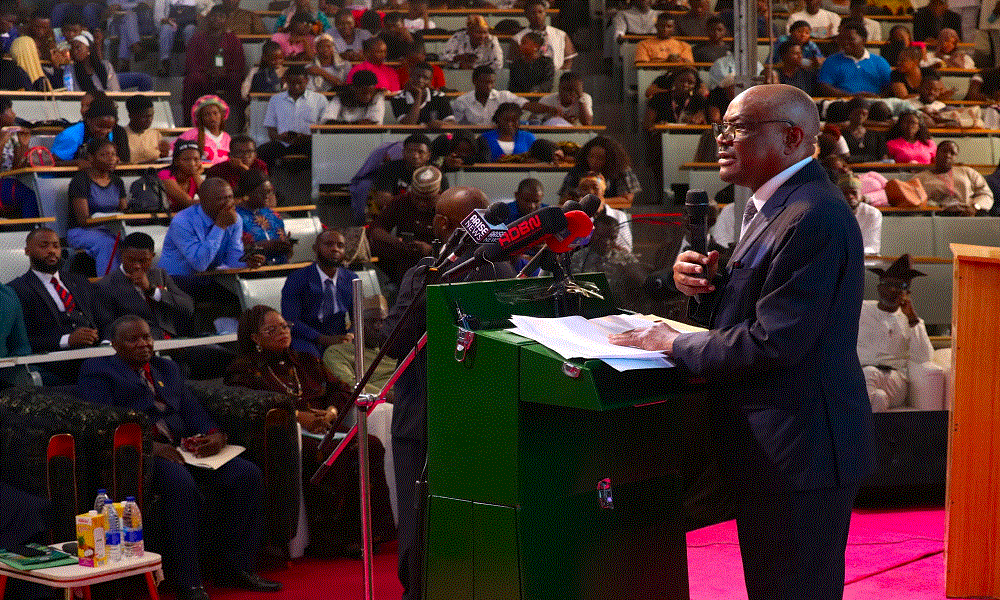
On Thursday, October 16, 2025, the House of Representatives Ad-hoc Committee on the Mismanagement of Oil Spill Clean-Up Funds in the Niger Delta convened a public hearing in Abuja to investigate alleged mismanagement of funds allocated for the cleanup exercise.
Declaring the session open, the Speaker of the House of Representatives, Rt. Hon. Tajudeen Abbas, represented by the Chief Whip, Hon. Usman Kumo, said the hearing became necessary to address accountability challenges that have affected the Ogoni cleanup and ensure that public trust is restored.
He stated that the committee’s mandate is to uncover the causes of mismanagement surrounding cleanup funds and identify individuals or institutions responsible for lapses in the implementation process.
“The House must investigate how the funds were utilized, assess the competence of those appointed to manage the projects, and determine whether there was accountability in the entire process,” Abbas said.
The Chairman of the Ad-Hoc Committee, Hon. Okpolupm Etteh, emphasized that the investigation was not a witch hunt but a fact-based inquiry designed to ensure transparency and restore public confidence in environmental remediation across the Niger Delta.
“The House has mandated this Committee to investigate the allocation, release, disbursement, and utilization of funds designated for oil spill remediation in the Niger Delta,” Etteh said. “Our goal is clear: to uncover the truth. We will scrutinize project implementation, procurement integrity, payment processes, inter-agency coordination, and the delivery of promised remediation to affected communities.”
Etteh stressed that witnesses and stakeholders appearing before the committee must provide full disclosure of records and documentation, adding that deliberate falsehood or obstruction of the investigation would attract sanctions.
During the hearing, representatives of TOTAL Nigeria revealed that NNPC, OANDO, and RENAISSANCE had collectively paid $900 million for the Ogoni cleanup.
The committee, however, requested more clarifications on the funds and gave the officials until next week to submit detailed reports.
Meanwhile, the Project Coordinator of HYPREP, Professor Nenibarini Zabbey, assured the National Assembly that the ongoing Ogoni Cleanup Programme is being executed with full transparency, accountability, and adherence to international best practices.
Prof. Zabbey, who appeared before the committee chaired by Hon. Okpolupm Etteh, said the funds have been judiciously utilized in accordance with the recommendations of the United Nations Environment Programme (UNEP) Report on Ogoni Environment.
He revealed that over 120 projects are currently ongoing under HYPREP, while several others have been completed.
These include simple-risk land remediation sites and the Phase 1 water projects that have already brought relief to many Ogoni communities.
Explainimg key achievements, Prof. Zabbey listed the provision of potable water to 40 Ogoni communities, the construction of a 100-bed Ogoni Specialist Hospital and the Buan Cottage Hospital, the Centre of Excellence for Environmental Restoration (CEER).
The Ogoni Power Project, mangrove restoration, land and shoreline remediation, alternative livelihood initiatives, capacity development, and peacebuilding programmes.
He reaffirmed that HYPREP operates in full compliance with the Public Procurement Act of 2007 and maintains an open-door policy that encourages public scrutiny.
To demonstrate its transparency, he invited the National Assembly Committee to undertake an on-the-spot assessment of all ongoing projects in Ogoniland, consistent with HYPREP’s “Come and See” mantra.
“We welcome oversight because it strengthens credibility,” Prof. Zabbey said. “Every contract, every project, and every payment we make is verifiable.
Our books are open.” Earlier, Rt. Hon. Emma Deeyah, Chairman of the Ogoni Trust Fund (OTF) Board of Trustees, commended the progress made by HYPREP and acknowledged strong financial support from Renaissance Africa Energy Company Limited (RAEC) and other joint venture partners.
Deeyah called on the National Assembly to consider institutionalizing HYPREP as a statutory government agency to ensure continuity and sustainability of the Ogoni cleanup programme.
Prof. Zabbey further explained that HYPREP conducts regular stakeholder engagements, publishes quarterly performance scorecards, and undergoes periodic audits by both internal and external auditors, including the Auditor-General of the Federation.
He added that HYPREP has established multiple oversight structures, such as the Milestone Evaluation Committee, Technical Coordination Committee (TCC), and Remediation Document Review Committee (RDRC), to ensure quality control, value for money, and strict compliance with technical standards.
However, environmental rights activist and former HYPREP Governing Council member, Akpobari Celestine, has rejected the House of Representatives’ move to probe the cleanup funds, describing it as an overreach and a potential political trap. Speaking on ARISE News on Friday, October 18, 2025.
Akpobari warned that the National Assembly lacks jurisdiction to investigate HYPREP since the funds are not part of federal allocations but contributions from oil companies as part of the Ogoni struggle settlement.
“There’s nothing wrong in finding out how money is used, especially when it’s public funds. But I smell a rat in this one,” Akpobari said. “The government of Nigeria does not appropriate this money.
The budget of HYPREP does not go to the National Assembly. The money being spent is not government money—it is the blood of the Ogoni people, the product of our struggle.”
He emphasized that only the Ogoni people or an independent auditor chosen by them should be permitted to review HYPREP’s finances. According to him, external probes from government circles could derail progress and erode community trust.
“If the minister of environment or the governing council wants to audit the process, that’s fine. If the community itself decides to hire an independent auditor, that’s even better,” he explained. “But people from government circles, especially the House of Representatives or Senate, have no moral right to do that. This is a community project funded by our sacrifice, not by federal allocations.”
Akpobari cautioned that the probe could destabilize peace and reconciliation efforts in Ogoniland, particularly at a time when President Bola Tinubu has made visible efforts to rebuild trust and promote inclusive development in the Niger Delta.
“What they are trying to do now could make people angry,” he warned. “It’s coming at a time when the government is trying to reconcile the Ogoni people and restore peace. This could easily be misinterpreted as another attempt to hijack the project.”
He further disclosed that HYPREP’s finances are managed through an account in London, jointly supervised by Ogoni representatives, the federal government, and oil companies, ensuring that no funds are spent without community consent. “A community person must sign before a kobo leaves that account,” he noted.
“So yes, there should be transparency, but these lawmakers are not the right people to probe.” Despite his strong stance, Akpobari praised the progress recorded by the current HYPREP leadership, acknowledging that the project is now on “the speed lane.”
He cited the planting of 1.4 million mangrove seedlings, the restoration of 560 polluted sites, and completion of 14 water schemes covering 40 communities, with plans to expand access to 60 communities before the end of the year.
“The Centre of Excellence is about 96 percent completed, the specialty and cottage hospitals are ongoing—it’s a construction site everywhere,” he said.
“The project is finally moving with the speed of light.” When asked if he would cooperate with lawmakers in their investigation, Akpobari refused.
“No, I don’t want them to reach out to me,” he said. “I’ve said my piece—this is not the right time or the right people to probe Ogoni cleanup funds.”