
By Jerry Needam
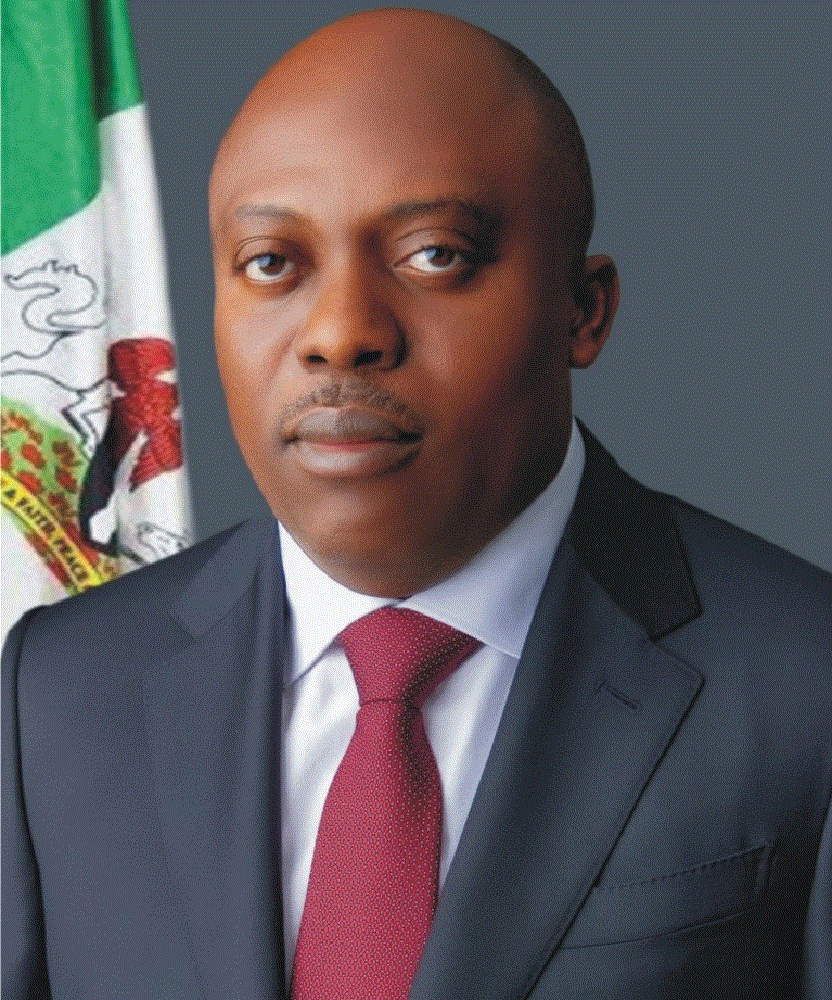
On Friday, May 29, 2026, Governor Siminalayi Fubara will mark three years in office as Governor of Rivers State — three years defined by intense political turbulence, institutional challenges, and yet remarkable resilience in governance and infrastructural development.
Sworn into office on May 29, 2023, Governor Fubara inherited not only the enormous expectations of Rivers people but also one of the most politically charged environments in Nigeria. What began as a transition of leadership soon snowballed into a prolonged political crisis that tested the stability of governance, democratic institutions, and the governor’s own political survival.
The fierce political face-off that engulfed Rivers State, particularly the divisions within the Rivers State House of Assembly and the wider power struggle in the state, created moments of uncertainty capable of distracting any administration from governance. Yet, despite the storms, Governor Fubara kept his eyes fixed on development, peace, and continuity of governance.
Indeed, one of the defining features of the Fubara administration over the last three years has been the governor’s calm disposition, political restraint, and refusal to abandon governance in the face of provocation and intense pressure. At critical moments, he consistently preached peace, dialogue, and stability, insisting that the interest of Rivers State must rise above political disagreements.
Beyond the politics, however, Governor Fubara’s administration has steadily pursued ambitious infrastructure renewal and people-oriented development programmes across the state.
Among the landmark projects under his administration is the massive Port Harcourt Ring Road project, a strategic road infrastructure designed to decongest traffic within the metropolis and stimulate economic growth across several local government areas.
The over 50-kilometre project remains one of the biggest infrastructure undertakings by any state government in Nigeria today.
Another major signature project is the Trans-Kalabari Road project, expected to link several riverine Kalabari communities to the mainland and open up new economic opportunities in areas that have remained largely inaccessible for decades. Governor Fubara has repeatedly assured residents of his administration’s commitment to delivering the historic project on schedule.
The administration has also made notable progress in road construction and rehabilitation across different parts of the state, including the Agba-Ndele Bridge and the adjoining Ndele-Omofo-Agba-Ndele Road linking communities in Emohua and Abua/Odual Local Government Areas.
The governor has already indicated that the project will be among those slated for commissioning as part of activities marking his third anniversary in office.
Other critical projects include the ongoing reconstruction of the Creek Road Market in Port Harcourt, urban renewal initiatives, expansion of internal road networks, and the construction of the 7.1-kilometre airport bypass road aimed at improving accessibility and addressing recurring traffic disruptions around the Port Harcourt International Airport corridor.
Equally significant is the renovation and modernization of the Rivers State Secretariat Complex, a project aimed at improving the working environment for civil servants and restoring efficiency within the state’s public service structure.
What is perhaps most remarkable is that many of these projects are being executed and prepared for commissioning at a time when the administration continues to grapple with political uncertainty and distractions that could easily have slowed governance.
Governor Fubara’s supporters argue that his greatest achievement may not only lie in physical infrastructure but also in his ability to sustain governance under extraordinary political pressure.
Despite the crisis, salaries have continued to be paid, government institutions have remained functional, and developmental activities have continued across various sectors.
In healthcare, education, youth empowerment, and social welfare, the administration has sustained interventions aimed at improving the quality of life for Rivers people. The governor has repeatedly emphasized inclusive governance, women and youth participation, and balanced development across all local government areas.
Critics may argue that the political crisis slowed certain aspects of governance and created avoidable instability. That may well be true. But even critics acknowledge that Governor Fubara has demonstrated unusual political endurance and administrative focus in circumstances that might have overwhelmed many leaders.
As Rivers State prepares for activities marking Governor Fubara’s third anniversary in office, including the commissioning of several completed projects, the moment offers an opportunity not only for political reflection but also for objective assessment.
Three years later, Governor Siminalayi Fubara’s administration tells a story of leadership under pressure, governance amidst storms, and an enduring determination to move Rivers State forward despite formidable political obstacles. The coming year will ultimately define the full legacy of his administration. But for now, one conclusion appears difficult to ignore: despite the turbulence, Rivers State has continued to move forward.