

Confusion has erupted online over a supposed 5% fuel surcharge under Nigeria’s new tax laws, with many fearing a sudden increase in fuel prices.
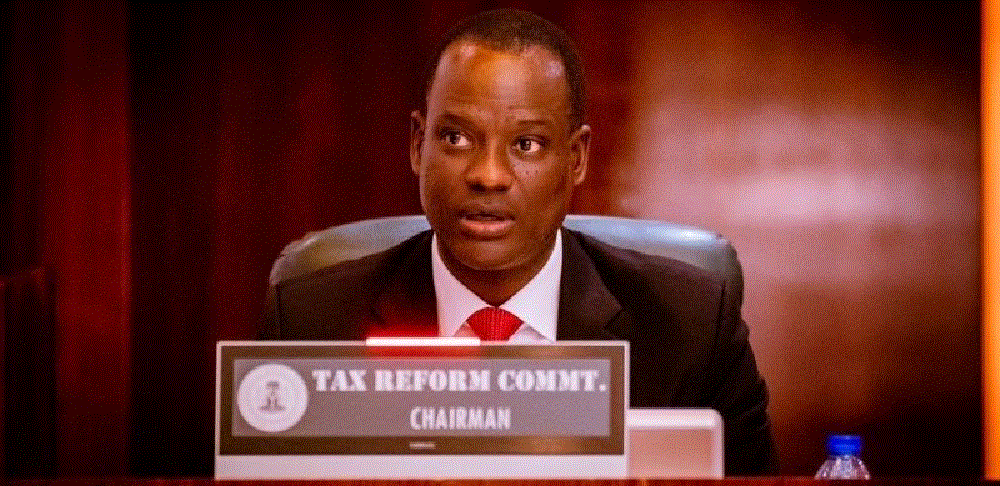
The chairman of the Presidential Committee on Fiscal Policy and Tax Reforms, Taiwo Oyedele, on Saturday through a post on X, clarified what is fact and what is fiction.
The controversy arises from the recent passage of the Nigeria Tax Act, 2025, which consolidates and harmonises previous tax laws.
Some social media posts suggested that President Bola Tinubu’s administration had introduced a new surcharge on fuel, sparking public concern.
Oyedele clarified: “The charge is not a new tax introduced by the current administration. The provision already exists under the Federal Roads Maintenance Agency (Amendment) Act, 2007. Its restatement in the new Tax Act is for harmonisation and transparency rather than immediate implementation.”
According to Oyedele, the surcharge is meant to fund road infrastructure, an area that has historically suffered from under funding.
Over the years, Nigeria’s road network has faced chronic maintenance challenges, resulting in potholes, travel delays, and higher vehicle operating costs.
Oyedele further noted that the surcharge is intended to create a dedicated, predictable funding source for road construction and maintenance.
Oyedele addressed key questions raised by citizens:
No. It will only take effect when the Minister of Finance issues an order published in the Official Gazette:
“The surcharge does not take effect automatically with the new tax laws.
It will only commence when the Minister of Finance issues an order published in the Official Gazette as stated under Chapter 7 of the Nigeria Tax Act, 2025.
This safeguard ensures careful consideration of timing and economic conditions before implementation,” Oyedele stated.
No. Household energy products such as kerosene, LPG, and CNG are exempt. Clean and renewable energy products are also excluded to support Nigeria’s energy transition agenda.
Oyedele explained that the fund is meant as a dedicated mechanism for road maintenance:
He said, “The surcharge is designed as a dedicated fund for road infrastructure and maintenance.
If implemented effectively, it will provide safer travel conditions, reduce travel time and cost, lower logistics costs and vehicle maintenance expenses, which will benefit the wider economy.
This practice is virtually universal with over 150 countries imposing various charges ranging between 20% to 80% of fuel products to guarantee regular investment in road infrastructure.”
The Chairman of the Committee on Fiscal Policy and Tax Reforms said: “While subsidy savings will provide some funding, they are insufficient to meet Nigeria’s huge and recurring road infrastructure needs among other public finance needs.
A dedicated fund ensures reliable and predictable financing for roads, complementing the budget and ensuring roads are not left underfunded.”
Oyedele reassured: “The reforms have already reduced multiple taxes and removed or suspended several charges that directly affect households and small businesses, such as VAT on fuel, excise tax on telecoms, and the cyber security levy.
By harmonising earmarked taxes, government is reducing duplication and ensuring a more efficient tax system.”
He clarified: “Yes, the surcharge has been removed from the FERMA Act and incorporated into the new tax laws which are designed to provide a forward-looking legal framework for Nigeria.
Keeping this provision in place within a harmonised legal framework ensures Nigeria is prepared to address critical challenges, such as sustainable road financing and even climate change impacts.
It is not about immediate implementation, but to ensure the law provides a clear and effective framework for when it becomes necessary in the future.” In summary, Oyedele stressed that the surcharge is not new, not immediate, and selectively applied. Its inclusion in the law is about transparency, preparedness, and sustainable funding for Nigeria’s roads, and it aims to address long-standing gaps in infrastructure financing.


