

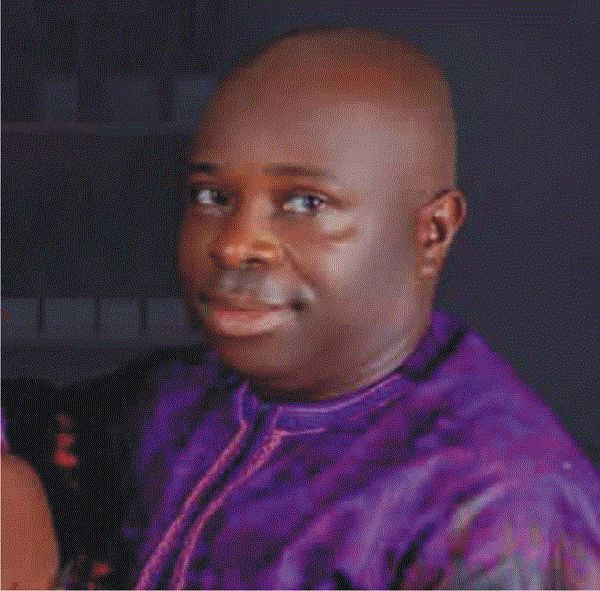
The Project Coordinator of the Ken Saro-Wiwa Foundation (KSWF), Barry Wugale, has called on Ogoni youths to consciously rebuild their minds and reclaim their true identity if they must rise again as a people of purpose, pride, and progress.
Speaking as keynote presenter at the 2025 Ogoni Youths Empowerment Summit (OYES) held in Bori, Wugale, in his paper titled “Re-Emerge: The Mindset for a Rising Ogoni,” declared that the re-emergence of Ogoni youths will begin only when they deliberately free themselves from systems that have psychologically, socially, and politically subdued them.
“It is not enough to talk about empowerment,” he said. “To re-emerge means the youths must come out of a system that has successfully swallowed them. But how can they do so if they do not even understand that the system was designed to weaken them and perpetuate their failure?”
Wugale, whose presentation coincided with the 84th posthumous birthday of Ken Saro-Wiwa, said it was symbolic that he stood before the youths to speak on re-emergence barely a day after celebrating the man who, at just 25, helped define the political consciousness of Ogoni.
He lamented that the present generation of Ogoni youths is being subdued by what he described as “four unconventional wars” — the sociological war, psychological war, war of incapacitation, and war of strategic silencing.
“The sociological war has quietly destroyed the very fabric that defines the collective identity and communal structure of our people,” Wugale explained. “The psychological war has made our youths accept poverty and mediocrity as destiny. The war of incapacitation compromises institutions meant to hold leaders accountable, while the war of strategic silencing uses conflict to eliminate or distract those who could challenge the system.”
Using the Pentadic Criticism theory developed by American scholar Kenneth Burke, Wugale urged the youths to introspect deeply, asking themselves key questions about what they are doing, why they are doing it, and how they have allowed older generations to hijack their space.
He faulted the dominance of overaged persons posing as youth leaders, saying: “When people who are over 40 or 50 years old still lead youth groups, they superimpose the ideologies of their generation on the true youths. The result is recycled ideas, expired leadership, and ideological confusion.”
According to him, the “curse of crude oil” and the “curse of partisan politics” under the control of Ogoni elites have combined to weaken the spirit of innovation, creativity, and intellectualism among young people.
“The Ogoni aristocrats, gerontocrats, and comprador-bourgeoisie have promoted ineptitude as a new culture.
They replaced meritocracy with mediocrity and creativity with sycophancy,” he said.
He condemned the growing culture of political crowd leasing, sycophancy, and social media propaganda among youths, describing them as “tools of self-destruction” and “weapons of distraction.”
Wugale urged the youths to sanitize their ranks, reclaim their identity, and demand structural reforms that promote education, innovation, and skill-based development over political patronage.
“The Ogoni youths must walk out of the shadow of political shenanigans and slick alliances,” he emphasized.
“They must demand a new framework that emphasizes mass qualitative education and skills development. Certification without creativity is a dead end.”
He also revealed that during the recent celebration of Ken Saro-Wiwa’s 84th posthumous birthday, the Foundation proposed an affirmative action demanding 10,000 compulsory university scholarships for Ogoni youths in disciplines such as environmental technology, sustainable development, agro-entrepreneurship, and environmental engineering.
In his concluding remarks, Wugale charged the young people to take inspiration from the short but impactful lives of Paul Naaku Birabi and Ken Saro-Wiwa, reminding them that “it was their works, not their age, that made them fathers of modern Ogoni.”
“The re-emergence of Ogoni youths begins not with money or politics, but with a change of mindset,” he said. “Until the youths decide to think differently, act differently, and live differently, Ogoni will remain in the shadows of its glorious past.”


